
Against the backdrop of continued growth in the ready-to-eat and prepared food sectors, high-viscosity products—distinguished by their dense nutritional profile and rich texture—are rapidly gaining market traction. However, their industrial-scale production places more stringent demands on sterilization processes. An emerging industry consensus holds that the essence of sterilizing high-viscosity foods is not merely to elevate temperature, but to ensure effective heat penetration into the product core.
Unlike water or low-viscosity liquids, high-viscosity foods exhibit limited fluidity and generate little to no internal convection. Heat transfer therefore depends primarily on the relatively slow mechanism of conduction. This gives rise to a typical challenge: while the exterior of the package may reach the target temperature, the internal “cold spot” may still fail to meet required sterilization conditions. Simply extending the heating duration may partially compensate for this, but often leads to over-processing, adversely affecting product texture, color, and nutritional integrity.
Consequently, conventional sterilization approaches based on static steam or basic temperature elevation are becoming increasingly inadequate for high-viscosity food applications.
The industry is therefore shifting toward process designs centered on improving heat penetration efficiency. By enhancing heat transfer capacity and uniformity, manufacturers aim to address the fundamental issue of insufficient heat reaching the interior of the product.
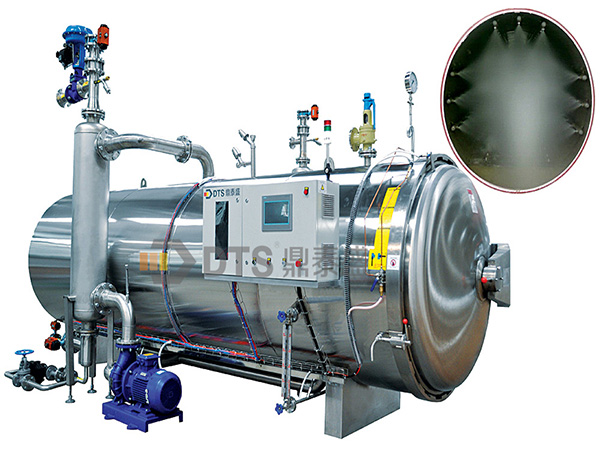
Sterilization methods represented by water spray technology are becoming widely adopted. Such systems utilize circulating water to maintain a stable and uniform heat transfer environment around the packaging. In combination with pressure control and optimized circulation design, they significantly enhance the efficiency of heat transfer into the product, thereby ensuring process safety while minimizing adverse impacts on product quality.
Consumer expectations for ready-to-eat foods have evolved from basic safety requirements toward a standard closer to freshly prepared products. This shift requires manufacturers not only to achieve commercial sterility, but also to preserve desirable texture, flavor, and visual stability. Accordingly, the selection of an appropriate sterilization process has evolved beyond a purely technical decision in production, becoming a critical factor influencing product quality and overall market performance.